
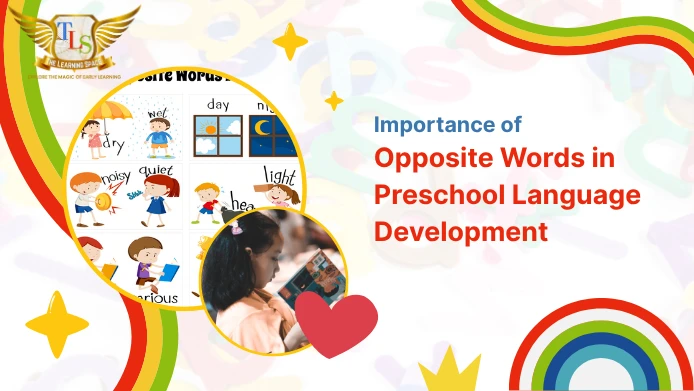
The Importance of Opposite Words for Kids
Language enables children to comprehend the world, communicate effectively, and vocalize their ideas. One of the enjoyable and simple methods of enhancing early education is teaching opposite words to kids. The basic word pairings are very important to preschool education. From saying “big” and “small” to understanding “hot” and “cold,” learning opposites helps children grow their language and thinking skills. In this blog, we’ll explore how important opposite words for kids, and how parents and teachers can make learning fun and easy. What are Opposite Words for Kids? Opposite words are words that mean something else. Like “up” and “down” or “open” and “closed.” They assist children in comparing two things and comprehending how they differ. Mastering opposite words in English for children is one of the very early steps in creating a solid vocabulary. List of 50 Opposite Words in English for Kids with Examples Here’s a table of 50 simple opposite words in English for children. These are ideal for classroom teaching or home teaching. You can make these flashcards or highlight them in real life S.No. Word Opposite Example 1 Big Small The elephant is big, but the rabbit is small. 2 Hot Cold The soup is hot, but the juice is cold. 3 Fast Slow The car is fast, but the bicycle is slow. 4 Happy Sad Tom is happy because he got a gift. 5 Up Down The bird flew up, and then it came down. 6 Open Closed The shop is open in the morning and closed at night. 7 Tall Short The giraffe is tall, but the deer is short. 8 Day Night We study during the day and sleep at night. 9 Clean Dirty Wash your hands when they are dirty to keep them clean. 10 In Out The puppy went in the house and then came out. 11 Full Empty My lunch box is full, but his box is empty. 12 Light Dark The room is light in the morning and dark at night. 13 Old Young The tree is old, but the plant is young. 14 Hard Soft The stone is hard, but the pillow is soft. 15 Near Far My school is near, but the airport is far. 16 Early Late Pooja arrived early, but her friend came late. 17 Wet Dry The towel is wet, so leave it outside to become dry. 18 Laugh Cry The funny clown made the children laugh, not cry. 19 Give Take Please give me the pencil, and do not take it away. 20 Come Go Please come inside instead of going outside. 21 Start Stop The race will start when the teacher says, “Go!” 22 Push Pull Push the door to open it and pull the handle to close it. 23 Buy Sell We buy toys from the shop, while shopkeepers sell them. 24 Above Below The clock is above the table, and the bag is below it. 25 Inside Outside The children are playing inside the house, not outside. 26 Thick Thin This book is thick, but that notebook is thin. 27 Strong Weak The strong horse can carry the heavy bag. 28 Right Wrong Your first answer is right, but the second one is wrong. 29 Same Different The twins have different shoes but the same uniform. 30 Sweet Sour The candy is sweet, but the lemon is sour. 31 New Old I got a new school bag to replace my old one. 32 Heavy Light The suitcase is heavy, but the small bag is light. 33 Loud Quiet The classroom was loud before the teacher made it quiet. 34 Bright Dull The stars look bright, while the cloudy sky looks dull. 35 Safe Dangerous The playground is safe, but the busy road is dangerous. 36 Kind Mean A kind child helps others instead of being mean. 37 Easy Difficult This puzzle is easy, but the next one is difficult. 38 Win Lose Our team worked hard to win the match, not lose it. 39 Begin End The movie will begin at six and end at eight. 40 Sit Stand Please sit on the chair and do not stand on the table. 41 High Low The kite is flying high, while the ball is down low. 42 Front Back The teacher is standing at the front of the class, not the back. 43 Warm Cool The soup is warm, but the juice is cool. 44 Enter Exit Please enter through this door and exit through the other one. 45 On Off Turn the fan on when it is hot and off when it is cool. 46 Before After Brush your teeth before bed and wash your face after playing. 47 Sharp Blunt The pencil is sharp, but the old crayon is blunt. 48 Awake Asleep The baby is asleep, while her brother is still awake. 49 Daytime Nighttime We play outside in the daytime and rest at nighttime. 50 Young Old The little puppy is young, while the dog is old. These are great examples for teaching opposite words for Kids in english. Why Opposite Words Are Important for Children? Opposites are not merely vocabulary. They make children better thinkers and give them an idea of how things operate. When a child learns “tall,” then he or she can comprehend “short” as well. Learning opposites for children enhances their skill to observe, compare, and state feelings or actions. It’s also an excellent means to make them better listeners—like “don’t push, pull the door open! Teaching kids Opposite words is a fun way to boost their thinking, vocabulary and communication skills, whether you’re teaching kids at home or in a classroom. Fun Ways to Teach Opposites for Kids Children learn best when learning feels like play. These strategies are fun, simple, and work well for teaching opposite words for in English for kids. Benefits of learning Easy Opposite Words in English for Kids Opposite words for kids are helpful in several aspects of child development, not only language. The following